If you’ve ever wondered how solitaire works or why this classic card game remains addictive even today, this friendly guide will walk you through everything you need.
Introduction: Why Solitaire Still Captivates Millions
There’s something wonderfully calming about solitaire. Maybe it’s the quiet rhythm of arranging cards, or perhaps it’s the tiny triumph you feel when everything lines up perfectly. Whatever the reason, solitaire—whether you call it classic solitaire, free solitaire, or simply the card game your computer came with—has earned a permanent spot in our digital routines.
I’ve personally seen people play it during lunch breaks, long flights, stressful evenings, and even while waiting for laundry to finish. And honestly? I get it. Solitaire is simple enough for anyone to learn, yet surprisingly strategic once you dig into it. If you’re new to the game or just curious about how to play solitaire properly, this guide breaks everything down step by step.
What Exactly Is Solitaire?
At its core, solitaire is a single-player card game designed to challenge your patience, pattern recognition, and a bit of luck. Traditionally played with a standard 52-card deck, the goal is straightforward: move all cards to foundation piles in ascending order, separated by suit.
Even though the game exists in dozens of variations, most people today are familiar with the version known as Klondike—the one bundled with early Windows computers. This is what many refer to as solitaire or classic solitaire.
Because solitaire became widely available digitally, many players now enjoy it as online solitaire or free solitaire through web browsers, phones, and apps. Regardless of the platform, the basic rules remain similar.
The Basic Setup of Classic Solitaire
Before you start playing solitaire, it helps to understand how the game layout works. Once you know the structure, everything else feels far less intimidating.
1. The Tableau
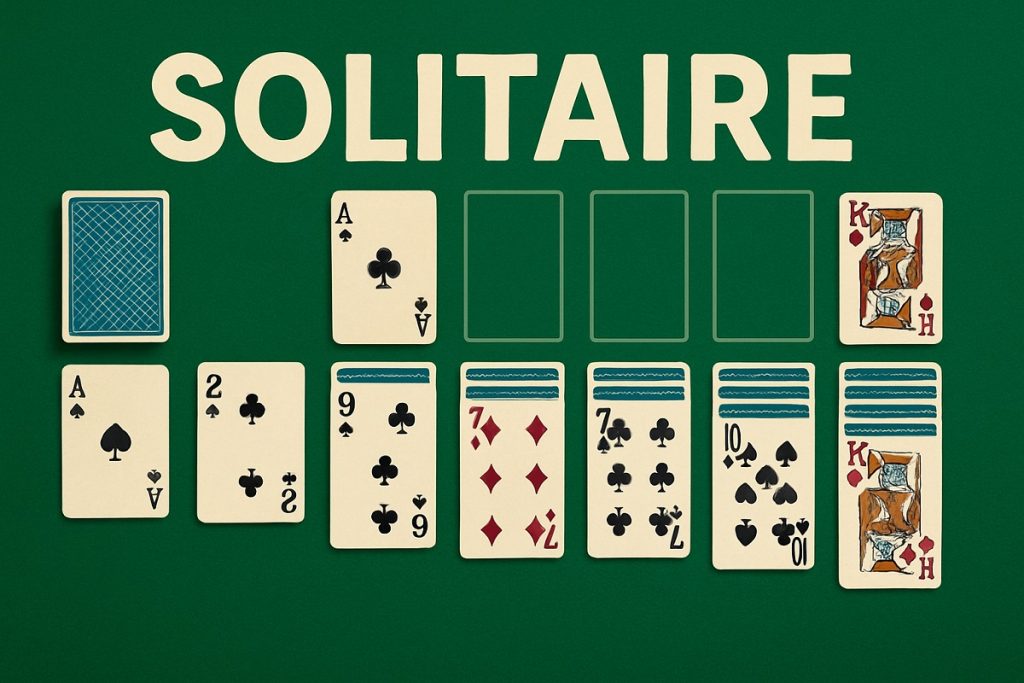
This is the main playing area where cards are laid out in seven columns. Each column increases by one card from left to right. The first column has one card, the second has two cards, and so on. Only the top card of each column is face-up; the rest remain face-down until uncovered.
2. The Stock
The remaining cards that aren’t in the tableau form the stock pile. You draw cards from here as you play solitaire.
3. The Waste Pile
When you draw cards from the stock, they land in a face-up pile called the waste. These are available for play unless covered by another drawn card.
4. The Foundation
The ultimate goal: four foundation piles—one for each suit—built from Ace to King in ascending order.
How to Play Solitaire: Step-by-Step Rules
Now that the layout makes sense, let’s walk through how to actually play solitaire. I’ll explain it in a natural, conversational way to make everything crystal clear.
Step 1: Look for Aces
The moment the cards are dealt, your eyes should naturally scan for Aces in the tableau. Aces are the starting point for all foundation piles, so moving them as soon as you spot them is essential.
Step 2: Reveal Face-Down Cards
Your next priority is to expose hidden cards. Anytime a top face-down card becomes available, flip it immediately. This keeps the game moving and opens up more opportunities.
Step 3: Build in Alternating Colors
In the tableau, cards can only be placed on cards of opposite color and in descending rank. For example:
- A black 7 (♣ or ♠) can be placed on a red 8 (♥ or ♦)
- A red Queen can be placed on a black King
Once you get used to this alternating-color rule, the entire game begins to flow much more naturally.
Step 4: Move Kings to Empty Columns
Only Kings—or stacks starting with a King—may be placed into empty tableau columns. This creates valuable space for reorganizing cards.
Step 5: Shift Cards to the Foundation
As you uncover Aces, 2s, 3s, and so on, start building your foundation piles. However, don’t move cards too quickly—sometimes leaving a card in the tableau temporarily helps open more moves.
Step 6: Use the Stock Wisely
The stock pile is your backup when you run out of moves. Depending on the solitaire variation, you may draw one card at a time or three cards at once. Pay attention to the rhythm. Sometimes I find myself pausing, thinking, “Okay, if I pull too early, I might block a card I’ll need later.”
Why Solitaire Is More Strategic Than It Looks
People often assume solitaire is all about luck, but that’s only partially true. Skill plays a huge role. You’re constantly making micro-decisions—should you uncover that column first, or save your King for another move? Should you move that 5 to the foundation now or keep it in the tableau to unlock a hidden card later?
When I first really learned solitaire (not just clicking around like I did as a kid), I realized how layered the strategy is. Playing mindlessly works sometimes, but to win consistently, you need a blend of foresight, patience, and pattern recognition.
Popular Variations of Solitaire
Although classic solitaire remains the fan favorite, many variations offer unique twists. Here are a few that might surprise you:
1. Klondike
The traditional version. This is the game people usually imagine when someone says “solitaire.”
2. Spider Solitaire
A more advanced version using two decks. Instead of alternating colors, cards are arranged in descending order by suit. It’s tough, but incredibly satisfying.
3. FreeCell
This one gives you “free cells” to temporarily store cards, leading to more strategic planning and fewer luck-based outcomes.
4. TriPeaks
Faster and more modern. You clear cards by selecting the next higher or lower rank, making it a fun, casual choice.
5. Pyramid Solitaire
Your job is to remove card pairs that add up to 13. It feels almost like a puzzle game.
The Benefits of Playing Solitaire
Even though solitaire might seem like “just a card game,” the impact it has on mental clarity is genuinely noticeable. Here are a few benefits I’ve personally felt and seen others talk about:
Stress Relief
Solitaire’s repetitive but engaging structure helps the mind relax. It’s just complex enough to distract you from worries.
Improved Focus
Trying to visualize moves ahead strengthens your concentration. After a few games, I often feel like my brain has rebooted.
Enhanced Problem-Solving
The strategic layers—deciding which moves to prioritize, balancing risks, observing patterns—improve reasoning skills more than you’d expect from a simple card game.
A Sense of Accomplishment
Let’s be honest: finishing a game feels surprisingly rewarding. You get that small dopamine boost that says, “Nice! I figured it out.”
Tips to Win Solitaire More Consistently
If you’re starting to get the hang of the game but want to win more often, these tips might help. They’re based on both common solitaire strategy and my own trial-and-error learning curve.
1. Always Flip the Hidden Card First
Uncovering cards increases your options. The more cards you see, the better your moves get.
2. Avoid Rushing Cards to the Foundation
It’s tempting to move every possible card to the foundation immediately, but this can freeze your tableau and ruin future moves.
3. Try to Keep the Longest Column Open
The biggest stacks hide the most cards. Prioritize exposing them.
4. Use Kings Carefully
Don’t drop your King into the first empty space you see. Sometimes waiting gives you more flexibility later.
5. Practice With Online Solitaire
One neat thing about playing online solitaire is that you can restart quickly, learn faster, and develop strategies naturally. Many sites offer free solitaire so you can play as much as you like.
Common Mistakes Beginners Make
Everyone makes these at first (I definitely did), so don’t feel discouraged if they sound familiar.
1. Ignoring the Waste Pile
New players often forget to track the waste cards, but remembering what you’ve already seen is a big advantage.
2. Creating Empty Columns Too Soon
It feels like progress, but if you don’t have a King ready, you waste the empty spot.
3. Moving Cards Without Intent
If a move doesn’t reveal a new card or help unlock another path, it might not be worth doing.
Should You Play Solitaire Online?
Honestly, yes—especially if you like convenience. Modern solitaire platforms load quickly, look clean, and track your statistics, which makes improvement easier. Plus, if you’re like me, sometimes you just want to squeeze in a quick five-minute game between tasks without hunting for a physical deck.
Where to Play Solitaire for Free
If you’re in the mood to try a smooth, distraction-free solitaire experience, you can enjoy a comfortable, modern interface here: https://solosolitaire.com/. It’s simple, fast, and honestly quite relaxing.
Final Thoughts
Solitaire may look simple from the outside, but once you start playing, you quickly realize how calming, thoughtful, and strangely satisfying it truly is. Whether you’re passing time, clearing your mind, or improving your strategic thinking, the game has a way of drawing you in. So go ahead—shuffle the virtual deck, take a breath, and see where the cards lead you.
If you found this guide helpful, feel free to share it or drop your thoughts. Happy playing!
What is your reaction to this?
 I liked it
 Wonderful
 Thanks
 Good
Good Hahaha !
 Incredible
 Interesting
 Wrong
Wrong